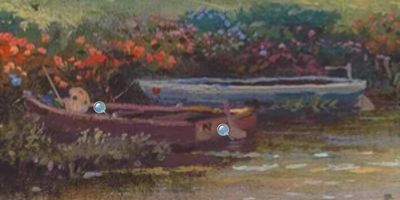
The Hidden Details in Thomas Kinkade Paintings: N’s, Love Notes, Easter Eggs & More
There’s More Hiding in a Kinkade Than You Think
One of the pleasures of owning a Thomas Kinkade painting is discovering that you can look at it for years and still find something you never noticed before. A tiny figure may be tucked into the landscape. A name might be painted onto a boat. Look even closer and you may discover a letter hidden in a tree, a building, or some other seemingly ordinary part of the scene.
Many of those details were no accident.
Throughout his career, Thomas Kinkade incorporated personal symbols, family references, initials, names, significant dates, and playful hidden objects into his artwork. Among the best known are the letter N's he concealed in honor of his wife, Nanette, but Kinkade's visual love notes extended to his daughters and other meaningful people, places, and moments in his life. Some paintings even became elaborate games of hide-and-seek, filled with animals, people, letters, and objects for collectors to find.
When these paintings were originally released, some of their secrets were documented in certificates, owner's materials, gallery literature, and other information provided to collectors. Decades later, much of that material is difficult to find. Paintings change hands without their original paperwork, old collector publications disappear, and information that was once readily available can become surprisingly elusive.
That's something we're hoping to change.
At Kinkade Collectibles, we're working to document the hidden details in Thomas Kinkade's paintings, painting by painting. We'll separate documented features from collector lore whenever possible, track down the stories behind them, and help you find those tiny details hiding in plain sight.
So take another look at that Kinkade you've had hanging on the wall for years.
There may be more in it than you think.
The Famous Hidden “N”s
Perhaps the best-known hidden feature in Thomas Kinkade's paintings is a simple letter: N.
The N stands for Nanette, Kinkade's wife and childhood sweetheart. Over the years, he developed a tradition of hiding the letter within his paintings as a personal tribute to her. Rather than simply signing her initial somewhere in a corner, Kinkade often worked the N into the scene itself, turning these little love notes into a challenge for collectors to discover.
And he could be sneaky about it.
A hidden N might appear in the branches of a tree, the lines of a fence or bridge, the architecture of a cottage, or another part of the landscape where intersecting shapes naturally form the letter. Some are relatively easy to spot once you know what you're looking for. Others can remain invisible even after you've spent several minutes staring directly at the right part of the painting.
There isn't a standard number of N's to find. Some paintings contain only a few, while others turn the search into a much larger scavenger hunt. The number itself could also carry meaning, giving collectors another clue to the personal story behind the painting.
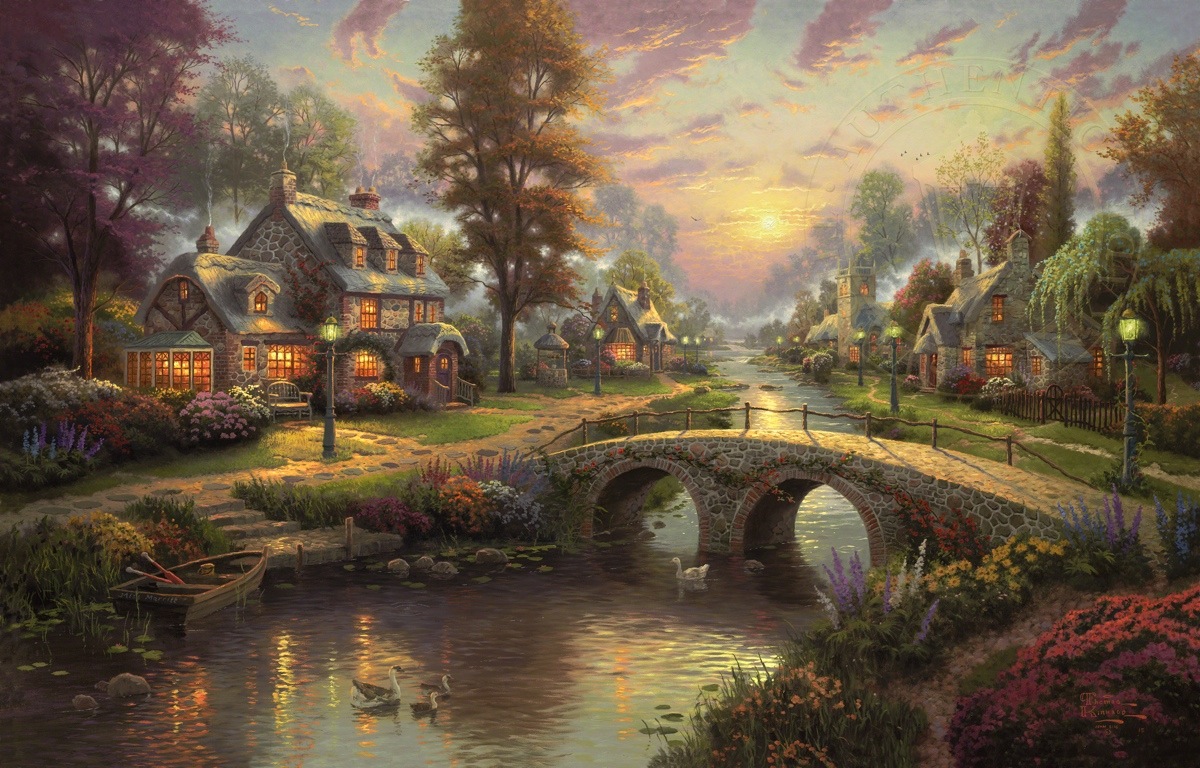
One particularly impressive example is Sunset on Lamplight Lane, the seventh and final painting in Kinkade's Lamplight Lane series. The painting is reported to contain 15 hidden N's in tribute to Nanette.
Finding all 15 is considerably harder than knowing they're there.
That's part of the fun of Kinkade's hidden N's. Once you've found your first one, your eye starts searching every tree branch, window frame, fence post, reflection, and patch of stonework for another. Suddenly you're no longer simply looking at the painting. You're exploring it.
And somewhere in there, Nanette is hiding.
How Do You Know How Many N's to Find?
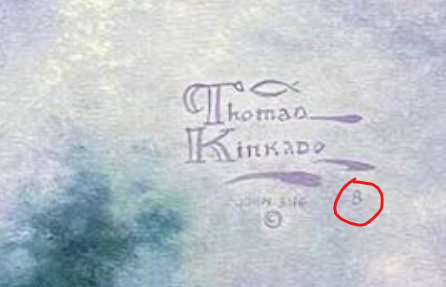
On many Thomas Kinkade paintings, you don't have to guess how many hidden N's you're searching for. Look closely near Kinkade's signature. A small number beside the signature can indicate the number of N's hidden within the painting. For example, Perseverance bears an 8 and is documented as containing eight hidden N's, while Sunset on Lamplight Lane bears a 15 and contains fifteen.
Kinkade’s “Love Notes”
The hidden N's may be Thomas Kinkade's most famous tribute to his wife, but Nanette wasn't the only member of his family to find her way into his paintings.
Kinkade often incorporated references to the people he loved into his artwork. Names and initials could appear on boats, signs, buildings, and other objects within a scene. Important dates might be tucked into a painting, while hearts and other personal symbols added another layer of meaning that wasn't necessarily obvious to someone seeing the artwork for the first time.
His daughters also became part of this visual family scrapbook. Their names or initials sometimes appear within paintings, turning otherwise ordinary details into something intensely personal. A boat isn't necessarily just a boat when it carries a daughter's name.
These details are sometimes referred to as Kinkade's "love notes." It's an appropriate description because many weren't intended to dominate the painting. They were small, personal messages woven into a much larger scene, waiting to be noticed.
That makes looking for Kinkade's hidden details different from an ordinary game of "find the object." Once you know the story behind a particular name, initial, date, or heart, you've learned something about the artist and what mattered to him when he created the painting.
It also means that identifying a hidden feature is only half the story.
The more interesting question is often: Why did Kinkade put it there?
Hidden People, Animals, and Objects
Not every hidden detail in a Thomas Kinkade painting carries a deeply personal meaning. Sometimes, it seems, Kinkade simply wanted to give collectors something fun to hunt for.
Look closely enough and you may discover animals, people, and everyday objects tucked into places where they're surprisingly easy to overlook. Cats and dogs appear in some scenes, along with ducks, birds, mice, and even owls. Tiny figures can disappear into the distance, while an artist with an easel, a painter's palette, a heart, or another small object may be hiding somewhere in a much busier landscape.
One of the best examples is Lamplight Village, a painting that came with its own elaborate game of hide-and-seek. Collectors were challenged to find dozens of details scattered throughout the scene.
Among the reported things to find are 12 ducks, three cats, four dogs, a mouse, an owl, an artist with an easel, a painter's palette, a man with a pipe, a person in a boat, hidden hearts, and numerous other people, animals, and objects. There are also family references and hidden N's mixed into the hunt, combining Kinkade's personal love notes with the more playful challenge.
It's the sort of painting that rewards getting very, very close.
A duck in the foreground may be easy enough to find. A tiny animal concealed among the cottages or a figure tucked into the background is another matter entirely. And once someone tells you that there's a mouse hiding somewhere in the painting, it becomes surprisingly difficult to stop looking until you've found the little guy.
That's part of what makes these details so much fun for collectors. They encourage you to explore a painting rather than simply view it. The cottages, gardens, streams, bridges, and distant figures stop being background scenery and become possible hiding places.
In other words, if Thomas Kinkade tells you there are dozens of things hidden in a peaceful little village, you should probably assume every shrub is suspicious.
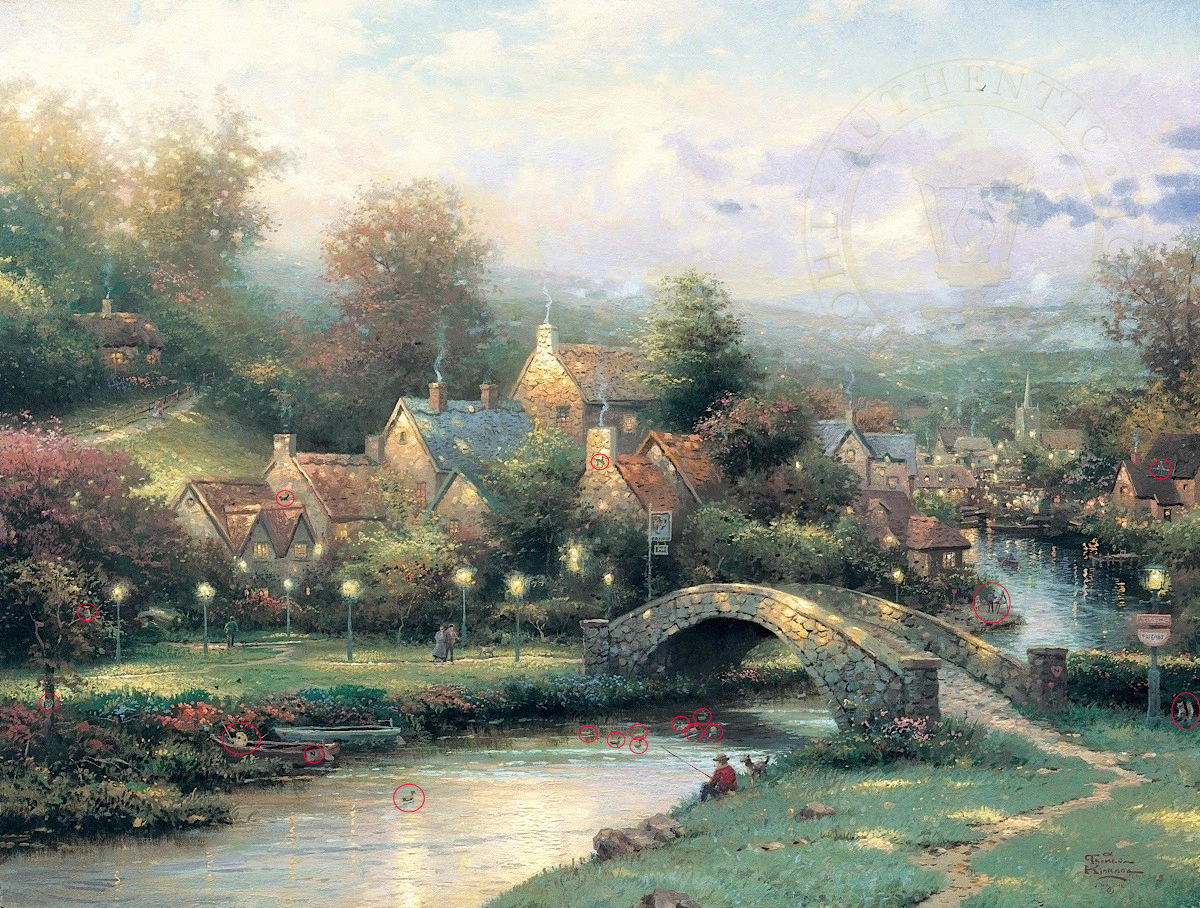 Not all hidden items are circled in this painting.
Symbols That Aren’t Necessarily “Hidden”
Not every meaningful detail in a Thomas Kinkade painting is an Easter egg.
Kinkade frequently used recurring imagery to help tell a story or convey a particular feeling. Light, pathways, open gates, bridges, churches, crosses, water, gardens, and smoke curling from cottage chimneys can all contribute to the meaning and atmosphere of a painting. These elements may be symbolic, but that doesn't necessarily make them hidden.
Light is perhaps the most obvious example. Kinkade didn't earn the nickname "Painter of Light" by concealing all the light behind a shrub. Glowing windows, brilliant skies, reflections on water, and warmly illuminated cottages are often among the first things we notice in his paintings.
Paths and open gates can suggest invitation, journey, or passage. Bridges physically connect one place to another and can also carry a symbolic sense of transition or connection. Churches and crosses bring unmistakable spiritual imagery into many scenes, while abundant gardens, flowing water, and welcoming cottages contribute to the sense of peace and refuge associated with much of Kinkade's work.
Even those wonderfully cozy smoking chimneys can help make an otherwise still cottage feel occupied and alive. Someone, we imagine, is home.
For our purposes, it's helpful to distinguish these symbolic elements from deliberately concealed details. A cross prominently displayed in a scene may carry considerable meaning without being hidden. A tiny cross worked almost invisibly into the landscape as something the viewer is challenged to discover would be a different matter.
The same rule applies to everything else. A lamppost isn't an Easter egg simply because Kinkade painted a lot of lampposts.
So as we document the secrets hidden within his paintings, we'll try to keep two questions separate: What does this painting symbolize, and what did Kinkade deliberately hide for us to find?
Sometimes the answers overlap. But they aren't necessarily the same thing.

Were Hidden-Feature Guides Included With the Paintings?
If Thomas Kinkade told collectors that a painting contained 15 hidden N's, dozens of objects, or some other special challenge, you might reasonably wonder: Did he also tell them where to find everything?
Sometimes, information about a painting's special features accompanied the artwork or was available through Kinkade galleries and dealers. Depending on the painting and edition, collectors might have received a Certificate of Authenticity, owner's materials, or other documentation containing information about the artwork. Galleries, dealer literature, catalogs, promotional materials, and collector publications could provide additional details about a painting's story and the things hidden within it.
Unfortunately, decades later, the painting and its documentation don't always remain together.
A Kinkade purchased on the secondary market may have changed hands several times before reaching its current owner. The Certificate of Authenticity might survive while other paperwork has disappeared, or the painting may arrive with no documentation at all. Even original owners may no longer have every brochure, newsletter, booklet, or other piece of material they received when they purchased their artwork.
The Internet hasn't preserved everything, either. Kinkade galleries have closed, dealer websites have vanished, pages have been redesigned, and information once published online may now exist only in archived copies. Printed material can be even more elusive.
The result is an odd situation: we may know that something is hidden in a Thomas Kinkade painting without having an easily accessible guide showing us where it is.
That's one of the reasons we're building the Kinkade Collectibles Hidden Details Guide.
We're working to gather this scattered information and document it painting by painting. Whenever possible, we'll trace hidden features back to original or reliable sources, record what collectors were told to look for, and ultimately help answer the question that inevitably follows:
Okay, I know it's in there. Now where the heck is it?
If you own original paperwork for a Thomas Kinkade painting that describes hidden details, we'd also love to hear from you. Collector materials tucked away in a folder or behind a framed piece may contain information that has become surprisingly difficult to find anywhere else.
Some Hidden Details Are Surprisingly Hard to Verify
You might think identifying the hidden features in a Thomas Kinkade painting would be simple. Find an old list, count the N's, locate the objects, and you're done.
We wish.
Once you start digging into these details, conflicting information isn't unusual. One source may give a different number of hidden N's than another. A shape that one collector confidently identifies as an N may look like nothing more than two conveniently crossing tree branches to someone else. An object may clearly be present in the painting, but that doesn't necessarily tell us whether Kinkade deliberately placed it there as an Easter egg or whether viewers simply discovered an interesting shape after the fact.
Even when a hidden object is intentional, its meaning can be another question entirely. It's one thing to establish that a heart, name, animal, or unusual object appears in a painting. It's another to claim that we know exactly why Kinkade put it there.
That's why we don't want the Kinkade Collectibles Hidden Details Guide to become a collection of Internet rumors repeated until they sound like facts.
As we research individual paintings, we'll generally think of hidden details in three categories:
Documented details are supported by Thomas Kinkade Studios, original collector materials, or other strong contemporary sources connected to the painting.
Reported details appear in reputable gallery or collector sources, but we haven't yet located the original documentation confirming them.
Unverified details include collector lore, claims repeated without a traceable source, and objects or symbols that viewers believe they can see but that we can't confidently establish were intentionally hidden by Kinkade.
That doesn't mean the unverified discoveries aren't interesting. In fact, some may eventually turn out to be completely legitimate. It simply means we'll tell you what we know, what the available evidence supports, and where there's still some uncertainty.
And if two original sources disagree about whether there are 12 hidden N's or 13?
We'll tell you that, too.
Half the fun may be finding Kinkade's hidden details. The other half, apparently, is figuring out which stories about them are actually true.
Examples of Thomas Kinkade Paintings With Hidden Features
Once you know Thomas Kinkade was fond of hiding personal references and whimsical details in his paintings, it's tempting to start examining every one with a magnifying glass.
And honestly, that's not a bad idea.
We're still researching which paintings contain documented hidden features and what, exactly, collectors were intended to find. But here are a few particularly interesting examples to get you started.
Sunset on Lamplight Lane
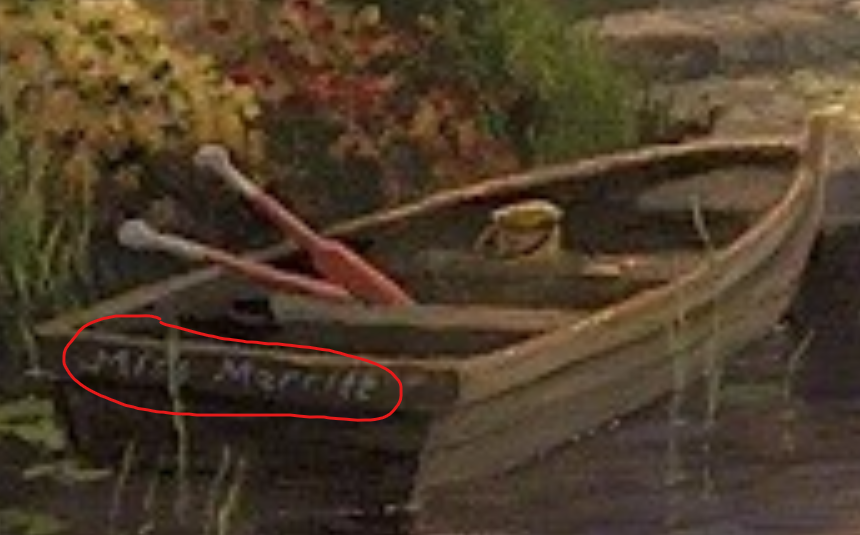
The seventh and final painting in the Lamplight Lane series contains 15 hidden N's honoring Kinkade's wife, Nanette. There's another family tribute in the foreground: the small rowing skiff is named "Miss Merritt" for Kinkade's oldest daughter. The boat was especially appropriate because Kinkade created the painting as Merritt approached her high school graduation, years after she had been a five-year-old child when the original Lamplight Lane was released.
Coming soon: See all the hidden details in Sunset on Lamplight Lane →
Lamplight Village
If you're looking for a serious Kinkade scavenger hunt, Lamplight Village may be hard to beat. Collectors were challenged to search the village for an artist with an easel, ducks, cats, dogs, a mouse, birds, hearts, a painter's palette, an owl, Kinkade's daughters Merritt and Chandler, and much more. One gallery source says there are more than 60 things hidden in the painting and that the original Certificate of Authenticity contained the complete list.
Interestingly, surviving sources even disagree about the number of hidden N's in Lamplight Village, making it a perfect example of why we're documenting our sources as we research these paintings.
Coming soon: See all the hidden details in Lamplight Village →
Lamplight Manor
Lamplight Manor, the sixth painting in the Lamplight Lane series, contains eight hidden N's in tribute to Nanette. Kinkade also honored his daughter Merritt by putting her name on the boat. Look closely at the manor itself, too: a Celtic cross appears on its massive chimney.
Coming soon: See all the hidden details in Lamplight Manor →
Paris, City of Lights
In Paris, City of Lights, Kinkade didn't merely hide letters. He put the Kinkade family into Paris.
Kinkade described himself as the artist wearing the red beret and painting the Café Nanette. Nanette appears with baby Chandler, while their daughter Merritt is nearby. Kinkade even signed the tiny canvas sitting on the street artist's easel, which he described as the smallest Kinkade signature he had ever painted. And, in keeping with tradition, there are 15 hidden N's for Nanette scattered throughout the painting.
Coming soon: See all the hidden details in Paris, City of Lights →
Perseverance
Perseverance, the first painting in Kinkade's Life Values collection, contains eight hidden N's honoring Nanette. The painting itself was inspired by Kinkade's experience aboard a sailboat off the California coast and became a visual meditation on perseverance and faith.
Coming soon: See all the hidden details in Perseverance →
These are only a few examples. Hidden N's, family names, tiny figures, animals, personal references, and other surprises appear throughout Kinkade's body of work.
As we verify them, we'll be creating individual Hidden Details Guides for these paintings and adding links here. The goal isn't simply to tell you that there are eight N's, a mouse, or somebody's name hidden in a scene.
We want to help you actually find them.
Can You Find Them All?
If there's one thing we've learned while researching Thomas Kinkade's hidden details, it's that there are probably more discoveries still waiting to be made.
So take another look at the Kinkade hanging on your wall.
Look at the branches of the trees. Check the stonework, fences, windows, boats, bridges, and reflections. Pay attention to tiny figures in the distance and objects that seem just a little too carefully placed. You may discover something you've walked past every day for years without ever noticing it.
And if you find something, we'd love to hear about it.
We're especially interested in hearing from collectors who still have the original Certificate of Authenticity, owner's manual, gallery literature, collector publications, or other documentation that describes hidden features in a Thomas Kinkade painting. Some of this information has become surprisingly difficult to locate, and materials tucked away in collectors' files may help answer questions that have been lingering for decades.
Have you found a hidden N? A family name? An unusual animal or tiny figure? Do you have an old guide telling you exactly what you're supposed to find?
Tell us about it.
As we research and verify these discoveries, we'll continue building individual guides showing what's hidden in Kinkade's paintings, the stories behind those details, and, whenever we can determine it, exactly where to find them.
Explore Our Thomas Kinkade Hidden Details Guides
Our Hidden Details collection is just getting started. As new guides are completed, you'll be able to explore individual paintings, learn what has been documented or reported about them, and put your own powers of observation to the test.
And remember: if you can't find that last hidden N, don't feel bad.
Thomas Kinkade had an entire painting to hide it in.
You only have two eyes.